

How To Survive Your First Trip To Black Rock City
By Brianna Randall
Last week my husband and I pedaled our rusty bikes into the center of Burning Man’s Black Rock City, a temporary, intentional gathering of 80,000 people in the middle of Nevada’s desert. It felt like entering another planet.
Colorful lights zoomed through the dark, attached to bikes, backpacks, hats and coats. Music thumped from all sides. People paraded by in costumes ranging from Star Wars look-a-likes to Gothic motorcycle gangs to mostly nude rave-goers. Illuminated art installations teemed with people who climbed, spun or swung from them. Vehicles converted into fire-breathing giraffes, giant sneakers, two-story-high baby strollers or chrome-plated DJ platforms trundled willy-nilly across the dusty playa.
Above it all, the Milky Way splayed out in celestial glory and lightning zagged down to kiss the mountains.
Burning Man, especially at night, is nothing short of mind-bending.
We watched in jaw-dropping wonder as an entire city of tents and RVs sprang up out of parched sand and human ingenuity. We experienced the magic and mayhem of living with, giving to, and receiving from total strangers. We had dozens of profound conversations, several spontaneous dance parties, and many hilarious double-takes.
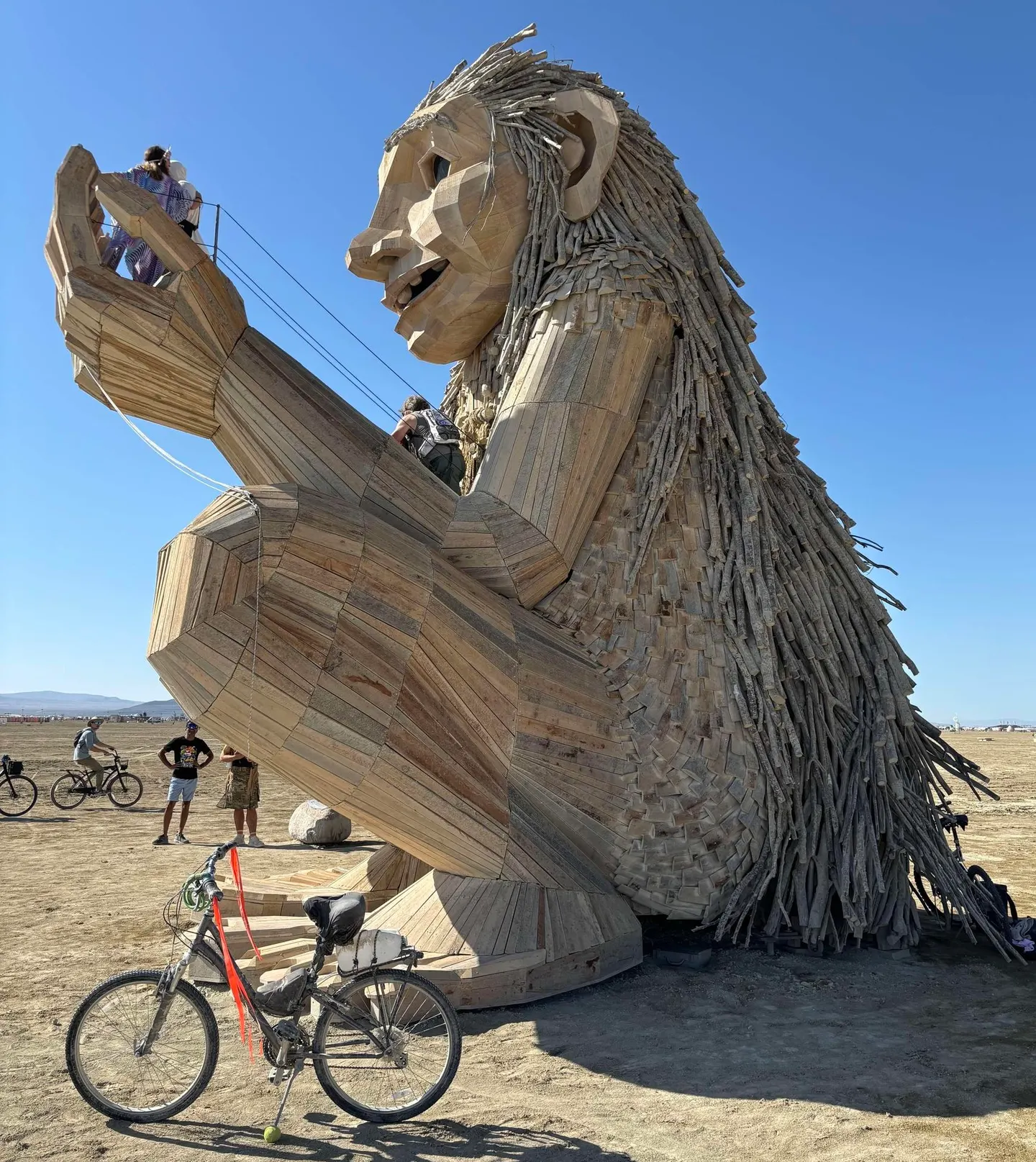
The art was my favorite part. Sculptures big and small radiated out in a mile-wide fan from the iconic five-story-tall wooden man (burned at the end of the week). Each time I biked through the wide-open playa, I stopped at different art projects.
An elk made of mosaic tiles and stained glass, built by a village of people in Mexico. A red-tailed hawk that circled above hand-woven hammocks, riding the thermals from a fire below it burning between a ball of metal redwoods. A wooden gazebo with a jukebox and dance floor just big enough for two. A free-standing granite arch that framed the moonrise.
The type of art at Burning Man “is an aesthetic of continuous reinvention”, writes Neil Shister in his book Radical Ritual: How Burning Man Changed the World. Temporary art is integral to the event, which began in 1986. “Objects are not sacrosanct, there are no DO NOT TOUCH signs. Things are conceived to be interacted with.”
Surviving The Elements At Burning Man
It wasn’t all light shows and wondrous art. We also endured a dust storm that nearly ripped our tent apart, thunderstorms that relegated us to take cover all night, and a rain event that turned the roads to unnavigable gumbo.
But the weather adversity made us that much more appreciative of the moments we got to engage fully in the community events—all of them free. Between storms, we built our own time capsules and volunteered to help build one of the art installations. We got our hair braided and helped fix broken bikes. We took a workshop on knot-tying and learned how to sail across the desert aboard a retrofitted boat.
The wild weather also made us more self-reliant (one of the ten principles of Burning Man) and spurred us to help any neighbors in need.
Would I go again? In a heartbeat. But as a newbie, I wish I’d known a few tricks for making my week in Black Rock City a little smoother.
Read my full story in Forbes to learn ten helpful hints for first-timers heading to Burning Man, accumulated from discussions with long-time volunteers, campers and other Black Rock devotees.