Saving the Sagebrush Biome
Scientists say it’s time to flip the script to conserve what’s left of the shrinking sagebrush biome
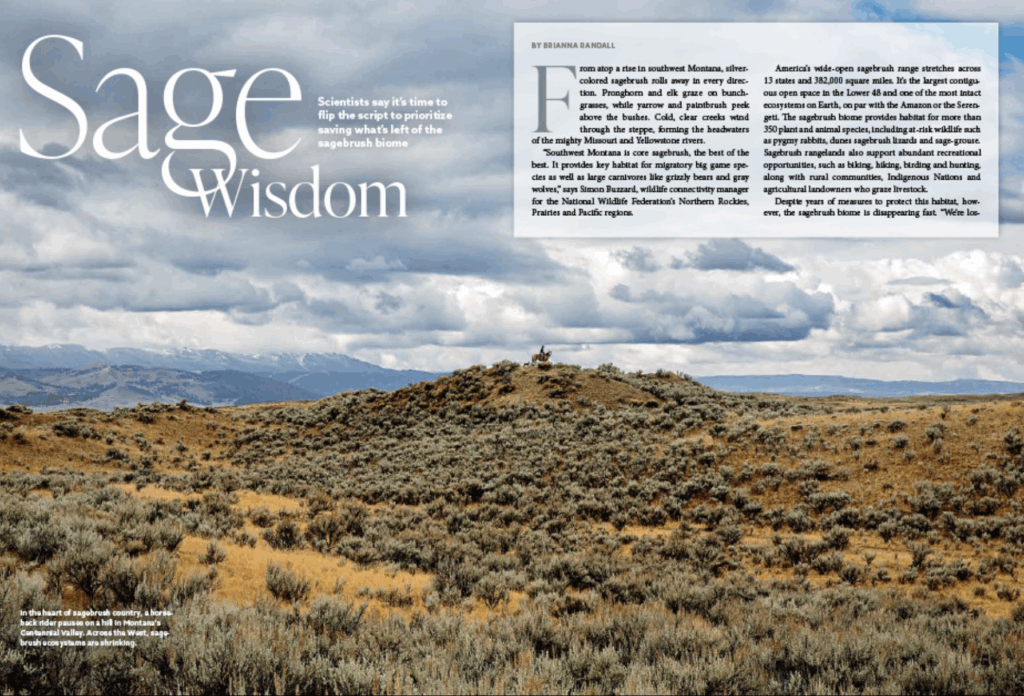
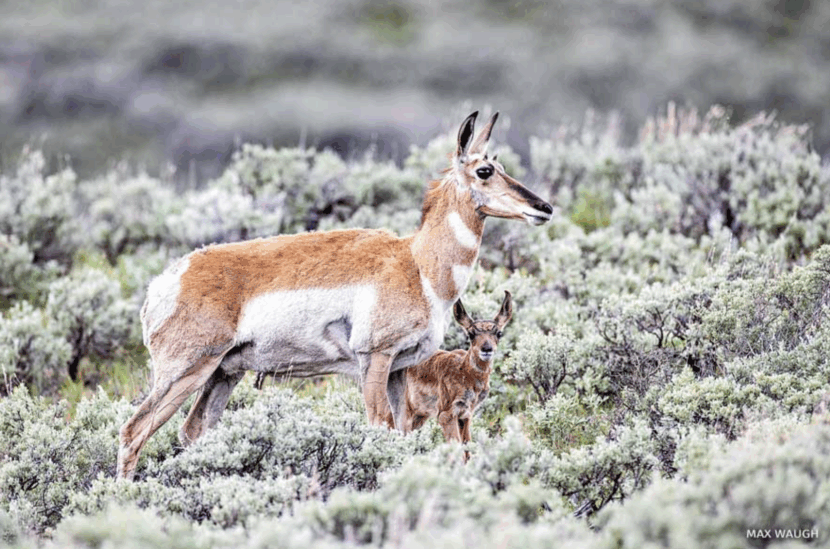
FROM ATOP A RISE IN SOUTHWEST MONTANA, silver-colored sagebrush rolls away in every direction. Pronghorn and elk graze on bunchgrasses, while yarrow and paintbrush peek above the bushes. Cold, clear creeks wind through the steppe, forming the headwaters of the mighty Missouri and Yellowstone rivers.
“Southwest Montana is core sagebrush, the best of the best. It provides key habitat for migratory big game species as well as large carnivores like grizzly bears and gray wolves,” says Simon Buzzard, wildlife connectivity manager for the National Wildlife Federation’s Northern Rockies, Prairies and Pacific regions.
America’s wide-open sagebrush range stretches across 13 states and 382,000 square miles. It’s the largest contiguous open space in the Lower 48 and one of the most intact ecosystems on Earth, on par with the Amazon or the Serengeti. The sagebrush biome provides habitat for more than 350 plant and animal species, including at-risk wildlife such as pygmy rabbits, dunes sagebrush lizards and sage-grouse. Sagebrush rangelands also support abundant recreational opportunities, such as biking, hiking, birding and hunting, along with rural communities, Indigenous Nations and agricultural landowners who graze livestock.
Despite years of measures to protect this habitat, however, the sagebrush biome is disappearing fast. “We’re losing 760,000 acres of core sagebrush each year,” says Tina Mozelewski, technical program manager at the nonprofit Spatial Informatics Group–Natural Assets Laboratory. “It’s a wake-up call that we need to change what we’re doing.” In 2024, Mozelewski and 70 other experts sounded that call, publishing a suite of sagebrush-related research in a special issue of Rangeland Ecology & Management (REM). Their research shows that to conserve what’s left of the sagebrush ecosystem, “business as usual is not going to cut it,” she says.
Two years earlier, local, state and federal partners had developed a framework, Sagebrush Conservation Design, to better target resources invested in the biome’s conservation. Based on satellite imagery that tracks vegetation over the past seven decades, the design delineated core and degraded sagebrush zones. Core areas have the highest amount of native shrubs and perennial plants and the least amount of invasive weeds or encroaching trees. “These are the places that have changed the least over time,” says Joe Smith, a rangeland ecologist at the University of Montana and a member of the Natural Resources Conservation Service’s Working Lands for Wildlife team that helped develop the framework.
Yet Mozelewski’s research reveals that between 2000 and 2020, only about 20 percent of all sagebrush conservation funding went to protecting these intact core areas, while 80 percent was spent on restoring degraded areas. She says that if we flipped the funding script—funneling 80 percent into protecting core areas—we’d be five times more effective at conserving the sagebrush biome. Nicknamed “defend the core,” this new approach is starting to catch on around the West.
Defending the core does not mean writing off degraded areas, Mozelewski notes, but changing why and how to invest in those places—building wildfire fuel breaks to protect communities or prioritizing key wildlife migration corridors, for example.
Buzzard agrees. “To conserve remaining big game migrations, we’re going to have to put some effort into degraded areas,” he says. But overall, he favors the focus on core habitat. “The primary reason that initial attempts to conserve and rebound declining sage-grouse were ineffective is because they were too species specific and did not take into account the full scope of habitat health,” he says. “NWF and our partners prioritize working in important, intact landscapes.”
Like Buzzard, others agree with the big-picture strategy but see the need for a nuanced approach at the local level. For more than 20,000 years, Indigenous Peoples from dozens of groups have inhabited the sagebrush biome. “For us, the sagebrush ecosystem is a source of medicine and food that we still utilize ceremonially,” says Jason Baldes, a member of the Eastern Shoshone Tribe in present-day Wyoming and director of NWF’s Tribal Bison Program. Bison, a keystone species of the sagebrush biome, once numbered 30 to 60 million. But due to the dispossession of Indigenous groups and the federal-government-sponsored slaughter of bison in the 19th century, bison are now considered ecologically extinct. Bringing bison back will require “out-of-the-box, landscape-wide conservation approaches,” Baldes says.