
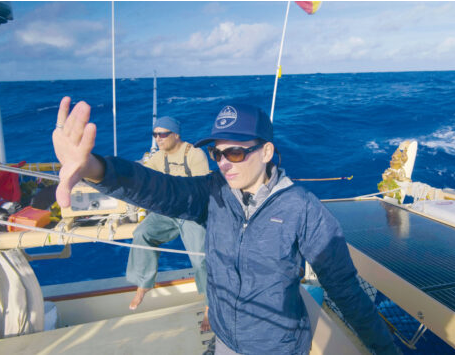
Ten Hawaiian sailors navigated 1600 miles of ocean with no GPS or compass, using only ancient Polynesian wayfinding.
The story below by Brianna Randall appeared in Yachting World on August 27, 2026.
(NOTE: My website was recently hacked. Apologies to those how received a spam email newsletter about home maintenance.)
From the Cook Islands to New Zealand is some 1,600 miles of open ocean. In November 2025 10 Hawaiian sailors cast off their lines to make the passage. The wind was whipping whitecaps. Palm trees quickly became specks as they headed south-west, the crew settling in for two weeks of watch changes, and praying the cold southern swells stay tame.
But this crew had set off on the open ocean voyage with no engine, no GPS, no autopilot, no paper charts – not even a compass. Instead, they were to navigate using only clues from nature: the position of stars, the direction of swells, the flight path of birds, the colour of clouds. After 15 days they arrived in the Bay of Islands.
This vessel accomplishing this feat was Hōkūle’a, a replica of a traditional double-hulled Polynesian voyaging canoe: it’s crew, six women and four men ranging in age from 25 to 66, led by the experienced navigator and captain Lehua Kamalu.
This iconic canoe has voyaged more than 280,000 miles over the past half-century, all of them without modern instruments. Its mission is two-fold: to prove that early Polynesian voyagers did not drift on the whims of chance, but intentionally navigated between far-flung islands in the largest ocean on earth; and to revitalise the ancient art of wayfinding.
This is not a purely historical study, however. In an age of ever-increasing technology at sea, this ancient art is attracting new sailors.
Zenith star
Hōkūle’a means ‘Star of Gladness’, which is what Hawaiians call the zenith star, also known as Arcturus. It’s one of more than 200 stars that traditional ocean navigators must memorise, along with where they rise and set on the horizon, to pilot their canoes across the sea.
But last November when Kamalu and her crew sailed Hōkūle’a toward the Southern Ocean, the stars were often hidden, and the constantly shifting winds blocked their second-most helpful navigation cue: swell direction.
“Without the waves or consistent stars, we spent all day trying to make sense of wind directions or trying to see if clouds were following patterns,” said Kamalu. “You’re looking for anything. It was a continuous search for signs.”
The passage to New Zealand also required a lot of sail adjustments with the fickle winds. Since the canoe isn’t very nimble, each tack requires forethought, teamwork and time.
“These vessels don’t like to go upwind. They have their own personalities. Our crew often joke that you don’t command a canoe, you negotiate with it, suggest a direction, adjust the sails, and see who wins,” Kamalu laughs.
Female sailors are playing a key role in this renewal of traditional navigation. Kamalu is expected to be one of the first women in known history to be granted pwo, or master navigator status (the current masters are five Hawaiian men who were granted pwo by Mau Piailug in 2007, along with Ka’iulani Murphy, also a navigator for Hōkūle’a).
To top off the navigation and sailing challenges, the Hawaiian crew – many of whom were serving on their first deep sea voyage – also endured cold, wet weather aboard a boat with no cabin, bimini or dodger. It was remarkably chaotic,” said Kamalu. “I can [laugh about it] now, but in the moment I was thinking, ‘Oh my gosh, this is really testing me’.”
There were deeply rewarding moments – as the canoe neared New Zealand’s North Island, marine life appeared in full force: whales surfaced, albatrosses wheeled, bait balls shimmered, and dolphins arced alongside.
The crew bonded over the rhythm of watch rotations and in the shared practice of an ancient art so much so that re-entry to modern life felt tough. “I tell the crew it’s a sign of success if you’re struggling when we get back from a voyage. It means we created a very special, very sacred space on board,” Kamalu says.
New generation
In the wake of wayfinding’s rebirth in Hawaii 50 years ago, many young people now learn the basics of traditional voyaging in school. Some continue their learning by volunteering to help maintain the canoes or sailing with the Polynesian Voyaging Society.
About one-third of the crew members on the Moananuiākea Voyage are in their 20s, like Lucy Lee, who crewed aboard Hōkūle’a from the Cook Islands to New Zealand.
“There’s definitely a demand for this type of education because navigation at its core is about learning how to make decisions,” says Lee, 25. While she loves voyaging, Lee also feels it’s important “not to be blinded by traditions” when we live in a society filled with technology. Instead, she believes in meshing indigenous and scientific knowledge in a way that fits today’s world.