Nothing like a DIY safari through Kenya for some family bonding time.
By Brianna Randall / Full story in Adventure Journal
I woke at two in the morning, bladder bursting, and strained to hear sounds of critters over the snores of my seven-year-old daughter. Nothing. Relieved, I unzipped the tent and cautiously scanned the African night with my headlamp before peeing. No elephants. No cape buffalo. No hyenas. And most importantly: no lions.
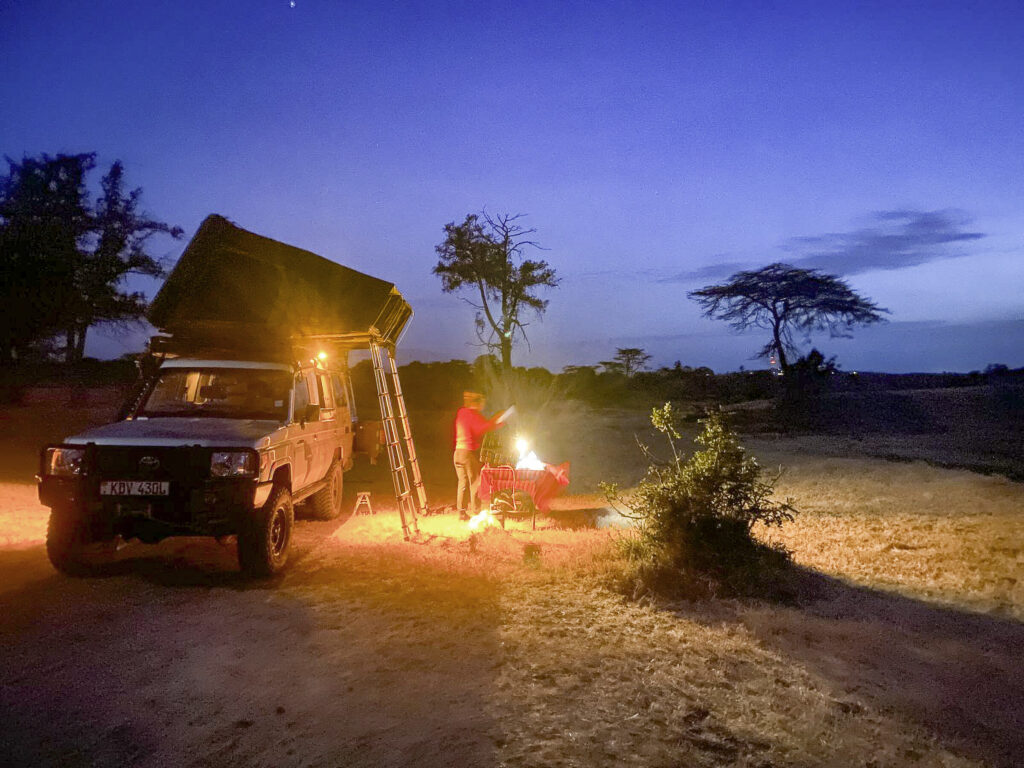
Mere moments after my family had climbed into the rooftop tent above our rented 4×4 earlier that evening, we’d heard a menacing rumble. It turned my stomach to liquid.
“What was that?” asked Talon, our eleven-year-old son.
“Sounded like a motorcycle,” my husband Rob answered. I assumed he was half-truthing so the kids wouldn’t freak out. Because every cell in my body knew without a doubt that it was a lion—and it was close.
We were alone in Lolldaiga Hills Conservancy, a forty-nine-thousand-acre wildlife reserve in northern Kenya, on the tail end of a DIY safari. There was no lodge for miles. No guide or guard in sight. And definitely no grrring motorcycles tooling around the rutted two-tracks in the pitch black.
The next growl was louder, closer, and answered by two more. A whole pride of lions commenced roaring, right from where we’d recently sat around the campfire. I could feel the vibrations in my chest.
“Don’t get down to pee tonight, Bri,” Rob advised. “Just go off the ladder.”
I eyed the top rung, which seemed easily in range of an ambitious lion. “I’ll just hold it.”
Eventually, I drifted off to sleep amidst the lions’ unsettling conversation, dreaming fitfully of feasting beasts. Then woke with a start hours later, dreading the fact that I had to pee. I levered out over the ladder like it was a portaledge on El Cap. Squeezing my eyes shut, I envisioned fangs sinking into my butt and pulling me into the bush with my pants around my ankles. Job done, heart thudding, I scrambled back inside.
The lions resumed growling before I finished zipping up the tent.
Why, you might be wondering, were we and our kids all alone with predators in the African wilderness? I was wondering that myself.
It was Rob’s idea. Three months previously, while lounging on our comfy fang-free couch in Montana, he announced, “I think we should head to Kenya for the last week of our trip in Africa. Let’s rent a rig and drive around by ourselves.”
I agreed. After guided tours around Tanzania, a self-guided road trip seemed like a good idea. Glamping in swanky lodges and being chauffeured between sundowners wasn’t my style. Indeed, the scheduled Tanzanian safari would be the first guided trip of my life—Rob and I preferred rambling around in our twenty-year-old Tundra, sleeping in patched-up tents, and letting the kids roll around in the mud. A DIY safari in Kenya would be a welcome reset back to our dirtbag values.
I knew it wouldn’t be easy to camp by ourselves in Kenya—especially coming from a five-star lodge where our every need was met. Plus, neither Rob nor I had ever traveled in mainland Africa. I anticipated hardship: slim food pickings. Few toilets. Rioting children who wanted out of the backseat. But I could handle those inconveniences. My bigger fears were animal-related: venomous snakes. Malaria-filled mosquitoes. Charging elephants.
I never considered the fact that driving would be the most likely thing to kill us in Kenya.
“The highway heading northwest is the most dangerous road in East Africa,” warned Joseph, the employee from the rental company who walked us meticulously through each butter knife, traction board, and charging port in our vehicle, which was nicknamed the Black Mamba. Joseph informed us that our rental contract forbade us from driving past dusk. And they’d know if we did, because there was a tracker in the Black Mamba. “You should leave immediately if you want to make it to Lake Naivasha tonight,” he added.
Rob and I exchanged a harried “we’ve-been-traveling-with-kids-for-twelve-hours-across-international-borders-and-still-have-three-hours-to-go” look, then hopped in the rig to get out of dodge.
Only to narrowly avoid colliding with a semi-truck that drifted into our lane. Rob swerved onto the red dirt shoulder. I gripped the oh-shit handle. The kids screamed. A herd of goats scattered, inches from becoming stew on our grill. Their brightly wrapped Maasai owner glared at us. I waved a weak apology.
Back on the blacktop, Rob started to get the hang of dodging semis through Nairobi’s chaotic roundabouts while driving on the left-hand side of the road from the right-hand side of the car. He didn’t seem nearly as concerned as I was by the lack of lane markers, road signs, or traffic lights. I relaxed a smidge.
Until Talon yelled, “Dad! Speed bump!” Our camping supplies launched skyward as we hit the bump at forty miles per hour. My head whipped within inches of the dashboard. Now it was my turn to glare.
“Who the hell puts speed bumps on a highway?” Rob grumbled defensively.
Only two and three-quarters hours to go until our first campsite. Were we having fun yet? Well, we were hungry, at least.

Between death-trap roundabouts, we’d managed a cursory run into a gas station mini-mart for some supplies. Our groceries consisted of rice, peanut butter, crackers, and cookies. I planned to stop for more food on the commute north. But the only “stores” we found were wooden crates selling mangoes.
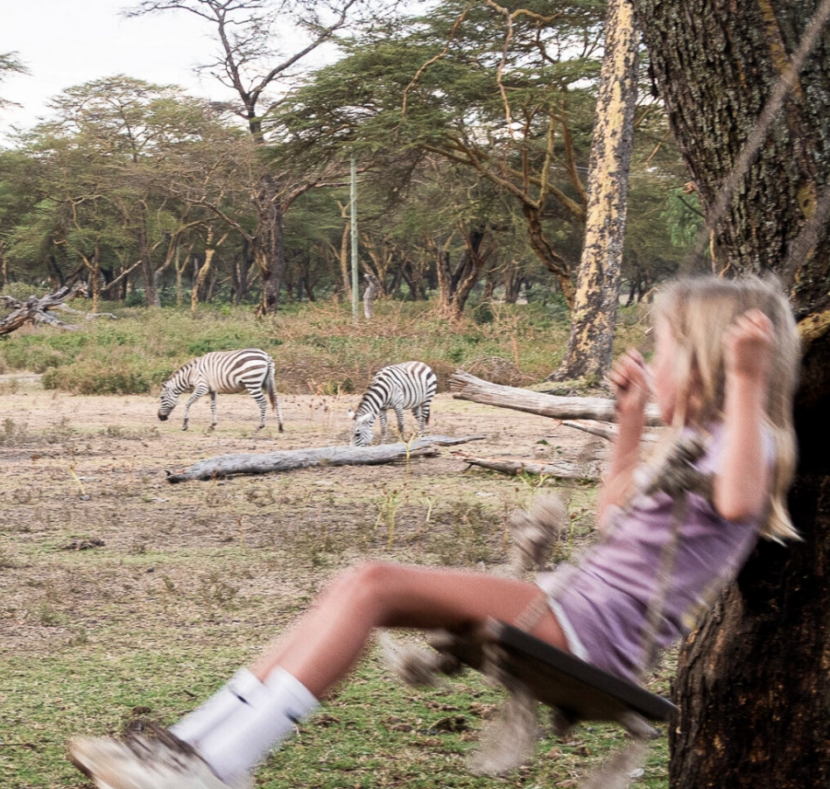
By the time we pulled into a small private conservancy on Lake Naivasha, my blood sugar level was critical and family morale was at rock bottom. Luckily, a herd of zebras was grazing a stone’s throw from the fenced campsite (whose highlight was flush toilets). The kids cheered and darted off to get closer.
I, meanwhile, stared hopelessly at the tangle of unfamiliar camping gear jigsawed into the back of our rig, trying to locate the propane and cookstove. Taking pity on me, Rob whipped up some rice cooked in coconut milk, which we paired with mango slices for dinner. We’d find protein another day. Probably.
The sun dropped like a rock at seven, along with the temperature. Although we were right on the equator, we had gained sixty-five hundred feet in elevation while rounding the southern flank of Mount Kenya. We layered up and dove into sleeping bags.
The next morning, I woke to my daughter’s excited voice ringing through the chilly air. “Look, everyone! Giraffes!” Lyra pointed through the tent mesh at a pair silhouetted against the rising sun. Inspired, we grabbed a handful of cookies and set off on a walking safari. Talon spotted a trio of bat-eared foxes, which we followed to their den. Lyra identified kingfishers, herons, and fish eagles on the lakeshore, already an expert wildlife watcher after two weeks in Tanzania. Impala bounded off as we meandered through knee-high grass. Perhaps most exciting of all, we stumbled upon a cafe that served breakfast. With protein.
When we hit the road again, I started Googling options for our next campground. It turns out, unplanned road trips are less fun in a foreign country, particularly one that’s not set up for self-drive safaris. That’s why most international travelers who want to rent their own 4×4 head to Namibia or South Africa, where there are smooth roads and excellent camping infrastructure.
We, of course, shunned the easy option. Harder is so much more memorable, after all. Driving in Kenya isn’t for the faint of heart. Signage is sparse. Ruts are deep. And the camping is either outrageously expensive, impossible to find, or a parking lot at a 1970s-era Boy Scout-esque compound. Entry into national parks like Samburu or Amboseli runs upwards of five hundred dollars per day for a car full of non-residents. It’s double that if you add in overnight camping fees. Large private conservancies cost almost the same amount.
Fortunately, a handful of community-run campsites have cropped up to capitalize on self-drive safari-goers looking for a patch of dirt to call home. These cost around fifty dollars per night and don’t need to be booked ahead of time. Using the Overlander app, I found one a few hours’ drive north that looked perfect.
If we could find it. Following sketched arrows on tiny cardboard signs stapled to trees, we navigated a maze of bone-jarring roads to a camping “resort” with a view of Mount Kenya. The quotation marks were well-earned: Other than a pool hovering around fifty degrees, the amenities included acacia thorns embedded in our sandals and a sludgy pond populated by two half-sunk pedal boats. We were the only campers, though, so the solitude was special.
In the late afternoon, we set out to walk through the nearby village. Before long, we’d collected an entourage of locals who giggled and pointed at the four mzungu walking down the road. I wondered if this was how those giraffes and foxes felt when we gawked at them. After posing for a slew of pictures with our new fan club, we passed out stickers to the children and canned goods to the women. I wished we had more to give.
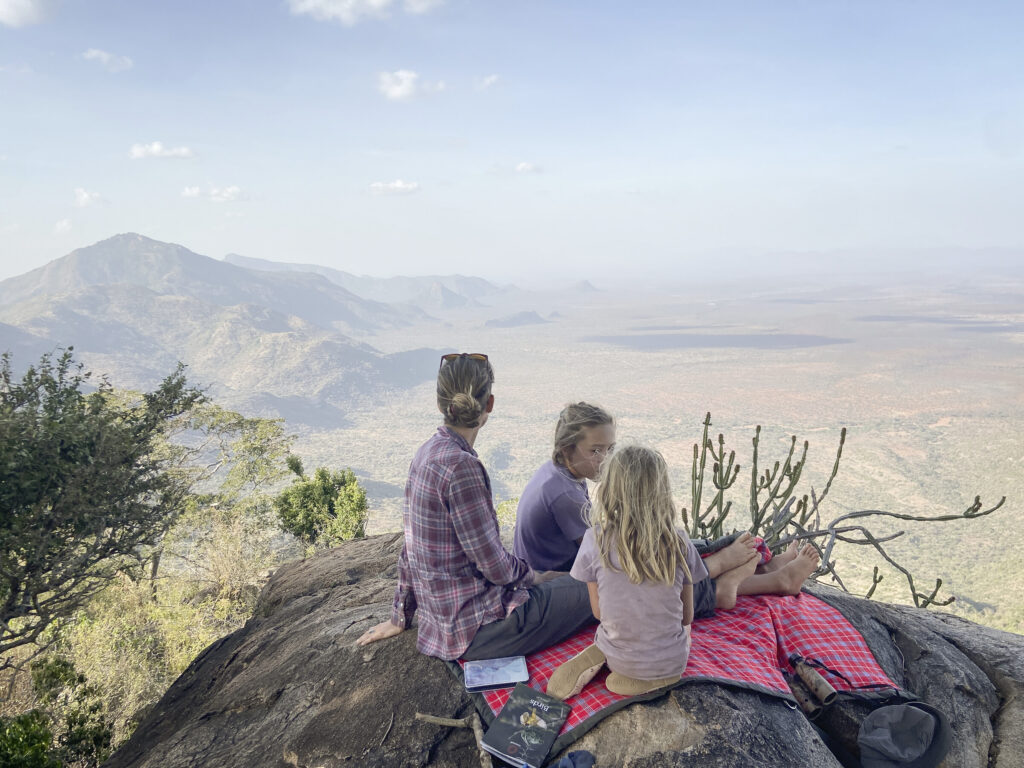
A couple of days later, Jasper, a very tall Kenyan guide, led us down a dusty trail, pointing out snake tracks and rhino poo. We were hiking through the Ngare Ndare Community Forest, which was managed in part by Jasper’s village and provided a much-needed corridor for animals to move between Mount Kenya National Park and protected private land. We encountered elephant bones, a few curious rock hyrax, and a pair of waterbuck resting in the shade.
As we crossed a narrow draw, Jasper nodded toward a muddy area twenty yards away. “Last fall, a cape buffalo charged us here while I was hiking with five British tourists. I had to shoot it five times.”
I gulped, glancing with newfound respect at the giant gun over his shoulder. Eyes saucer-wide, Talon asked, “What did the tourists do?”
“They ran away very fast.”